
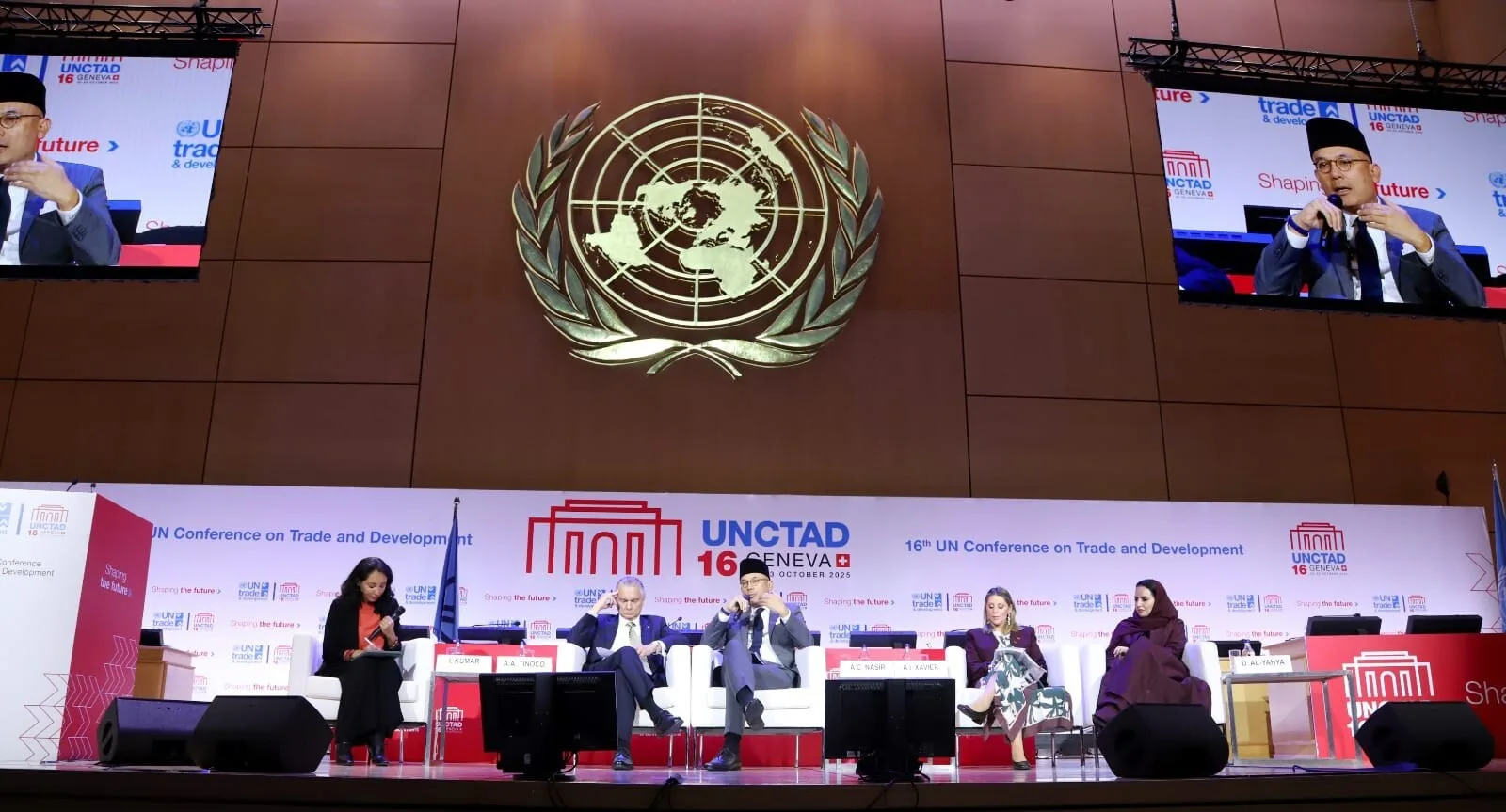
ASIATODAY.ID, GENEVA – A new milestone in Indonesia’s digital transformation was marked through a strategic collaboration between the Government of Indonesia and the UN Conference on Trade and Development (UNCTAD), reinforcing efforts to build a resilient, inclusive, and sustainable digital economy ecosystem.
During the 16th UNCTAD Ministerial Conference (UNCTAD16) in Geneva, Indonesian Vice Minister for Foreign Affairs, Arrmanatha Christiawan Nasir, and UNCTAD Secretary-General, Rebeca Grynspan, launched the eTrade Readiness Assessment for Indonesia, a flagship joint initiative designed to identify pathways for strengthening Indonesia’s digital economic framework.
“As an archipelagic nation, Indonesia places great importance on connectivity. It is not only about linking islands but also connecting people to education, markets, and a better future,” said Vice Minister Arrmanatha Nasir, known as Tata, during the Ministerial Roundtable on the Digital Economy, October 23, 2025.
Accelerating Inclusive Digital Transformation
Vice Minister Tata highlighted Indonesia’s major national programs that underpin its digital acceleration agenda, including:
the Palapa Ring Project to expand broadband infrastructure,
the Digital Talent Scholarship to develop a new generation of tech professionals, and
the Digital Leadership Academy to nurture digital-ready leaders across sectors.
“Indonesia’s digital transformation must be grounded in inclusivity and social justice. No one should be left behind in our journey toward the digital future,” Tata emphasized.
He also underlined Indonesia’s focus on empowering MSMEs, improving digital governance, and advancing innovation in artificial intelligence (AI) and green data centers to foster a sustainable green digital economy.
The session, opened by UNCTAD Secretary-General Rebeca Grynspan, was attended by the Ministers of Saudi Arabia, Costa Rica, and Portugal, who all recognized Indonesia’s leadership in digital economy cooperation among developing nations.
Digital Diplomacy on the Global Stage
On the sidelines of UNCTAD16, Vice Minister Tata held a series of bilateral meetings with global counterparts, including WIPO Director General Daren Tang, Finland’s Permanent Secretary of State Jukka Salovaara, and Brazil’s Secretary of Economic and Financial Affairs Philip Fox-Drummond Gough.
In meetings with Brazil and WIPO, Indonesia underscored the urgency of multilateral reform, including within the WTO, to ensure global trade frameworks keep pace with digital transformation.
Indonesia also advocated for greater transparency in global royalty governance through a digital global database that would strengthen collective management organizations (CMOs), particularly in the Global South.
Meanwhile, Finland praised Indonesia’s Free Nutritious Meal Program (MBG), commending it as an innovative policy to improve nutrition, education, and local economic resilience.
“Through partnership with UNCTAD, Indonesia remains steadfast in building an inclusive, fair, and competitive digital future,” Vice Minister Tata concluded.
UNCTAD16: Indonesia Pushes for a Fair and People-Centered Global Economic Transformation
At the General Debate of the 16th UNCTAD Ministerial Conference, Vice Minister Arrmanatha Nasir reaffirmed Indonesia’s vision that global economic transformation must be fair, inclusive, and centered on people’s welfare.
“The goal of transformation is not merely to chase profit but to uplift the dignity and well-being of humanity. This is no longer a choice—it is an existential necessity for our collective survival,” he stated firmly.
Amid today’s multidimensional crises, Tata urged reform of global economic governance to make it more inclusive, responsive, and equitable—particularly for developing nations.
Prabowo–Gibran Administration: Growth for the People
He highlighted that the administration of President Prabowo Subianto and Vice President Gibran Rakabuming Raka places people’s welfare at the heart of economic policy.
“Through the Free Nutritious Meal Program (MBG), Indonesia is delivering transformation through nutrition—strengthening health, education, and equality while driving rural economies,” Tata said.
Indonesia also continues to promote digitalization and downstream industrialization to enhance value creation, generate jobs, and support the green energy transition.
Aligned with this vision, during the G77+China Ministerial Meeting, Indonesia called for a more agile and responsive UNCTAD capable of addressing the evolving needs of developing countries and fostering global solidarity.
Geneva Consensus: A New Roadmap for Equitable Development
The UNCTAD16 Ministerial Conference, held at the United Nations Office in Geneva on October 20–23, 2025, adopted the theme:
“Shaping the Future: Driving Economic Transformation for Equitable, Inclusive, and Sustainable Development.”
Attended by around 90 ministers and vice ministers from member states, the conference reaffirmed UNCTAD’s vital role as the UN’s focal point for trade and development, strengthening capacity-building, policy research, and intergovernmental dialogue for developing nations.
The meeting concluded with the adoption of the Geneva Consensus, a landmark policy framework that will guide UNCTAD’s strategic direction for the next four years—anchoring its mission on fairness, inclusivity, and sustainability in global economic development. (AT Network)
Follow Us at Google News and WA Channel