
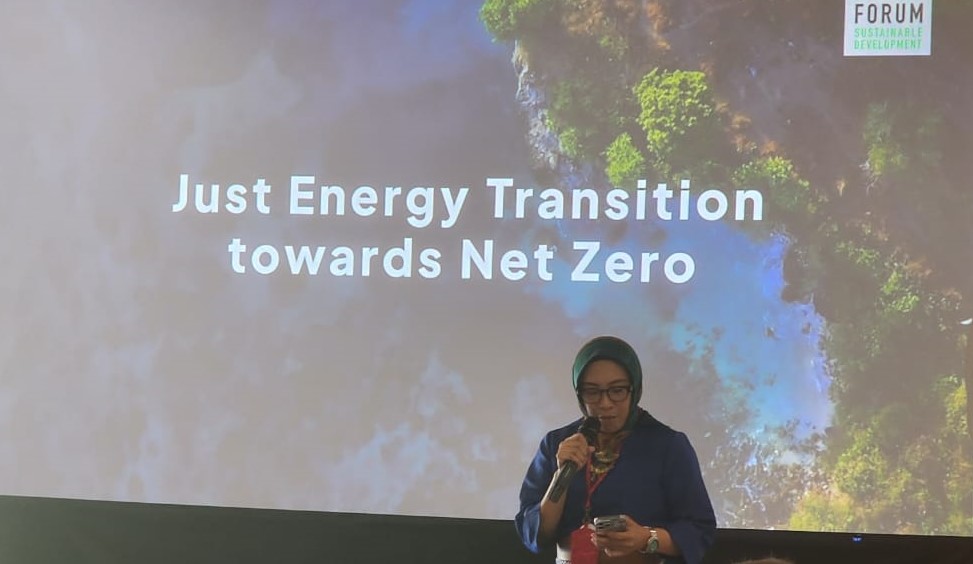
ASIATODAY.ID, DENPASAR – The world community is currently faced with the global challenge of climate change. To overcome this, global collaboration is needed through the energy transition.
Energy transition is a long-standing global strategy to reduce greenhouse gas emissions, achieving Net Zero Emissions (NZE).
“There is no transition without international cooperation and interconnection. There is no security without interconnectivity. There is no success without universal energy access. Collaboration and participation of all stakeholders is needed to achieve a Just Energy Transition and fulfill the Climate Change Mitigation Goals,” said the Director General of New Renewable Energy and Indonesian Energy Conservation, Eniya Listiani Dewi at a dialogue forum organized by Tri Hita Karana together with the World Economic Forum in Bali, Sunday, 19 May 2024.
Implementing the energy transition requires innovation and collaboration from all stakeholders.
“Global actors need to fulfill their responsibilities to provide innovation support, technology transfer, knowledge sharing, green finance, and collaboration to accelerate a just and equitable transition by empowering communities, increasing competitiveness, value chains, and sustaining long-term economic growth,” explained Eniya.
NBS Indonesia Reaches 1.5 GT CO2 Equivalent per Year
Indonesia’s Coordinating Minister for Maritime Affairs and Investment, Luhut Binsar Pandjaitan, said that Indonesia has great potential to utilize its natural resources sustainably and generate income from carbon sales.
Based on research by various institutions including Mc Kinsey, Indonesia is estimated to have Nature Based Solutions (NBS) or Ecological Based Approach (EBA) which reaches 1.5 GT CO2eq per year, around US$ 7.1 billion.
“We are now working towards a net-zero future. Referring to the UAE COP28 Consensus, all parties are committed to shifting away from fossil fuels, accelerating ambitious and economic-scale NDC emissions reductions, and pushing for a tripling of renewable energy and a doubling of efficiency energy by 2030,” said Luhut.
Luhut touched on Indonesia’s initiative on the sidelines of the G20 Summit, namely the Global Blended Finance Alliance (GBFA), which he said could also be a solution to facing the global challenge of climate change.
“GBFA also supports the achievement of the SDGs for developing countries, LDCs, island nations, and the Global South Collaboration. Through GBFA, we are laying the foundation for transformative change, leveraging blended finance and future knowledge to accelerate value creation and investment in economic sectors “main areas such as energy, forests, blue economy, including mangrove and seagrass forests, infrastructure health, and tourism sustainability,” explained Luhut.
Luhut added, GBFA is not only a solution to overcome the energy transition, but Indonesia is also leading in the field of forests and mangroves as part of Nature-Based Solutions for climate action.
In line with this, the Indonesian Minister of Energy and Mineral Resources, Arifin Tasrif hopes that GBFA can help Indonesia realize Net Zero Emission (NZE) by 2060.
“We also hope that the G20 Bali Global Blended Finance Alliance (GBFA) can support our program to realize Net Zero Emissions by 2060,” said Arifin.
To make this happen, the government’s NZE will diversify energy by optimizing the use of renewable energy sources.
“We are confident that we can achieve the target and implement the road map, even though there are several challenges,” concluded Arifin.
Energy diversification is the key to achieving net zero emissions by 2060. With commitment and cooperation from all parties, this target can be achieved and Indonesia can move to a cleaner and more sustainable energy future. (AT Network)
Follow Us at Google News and WA Channel