
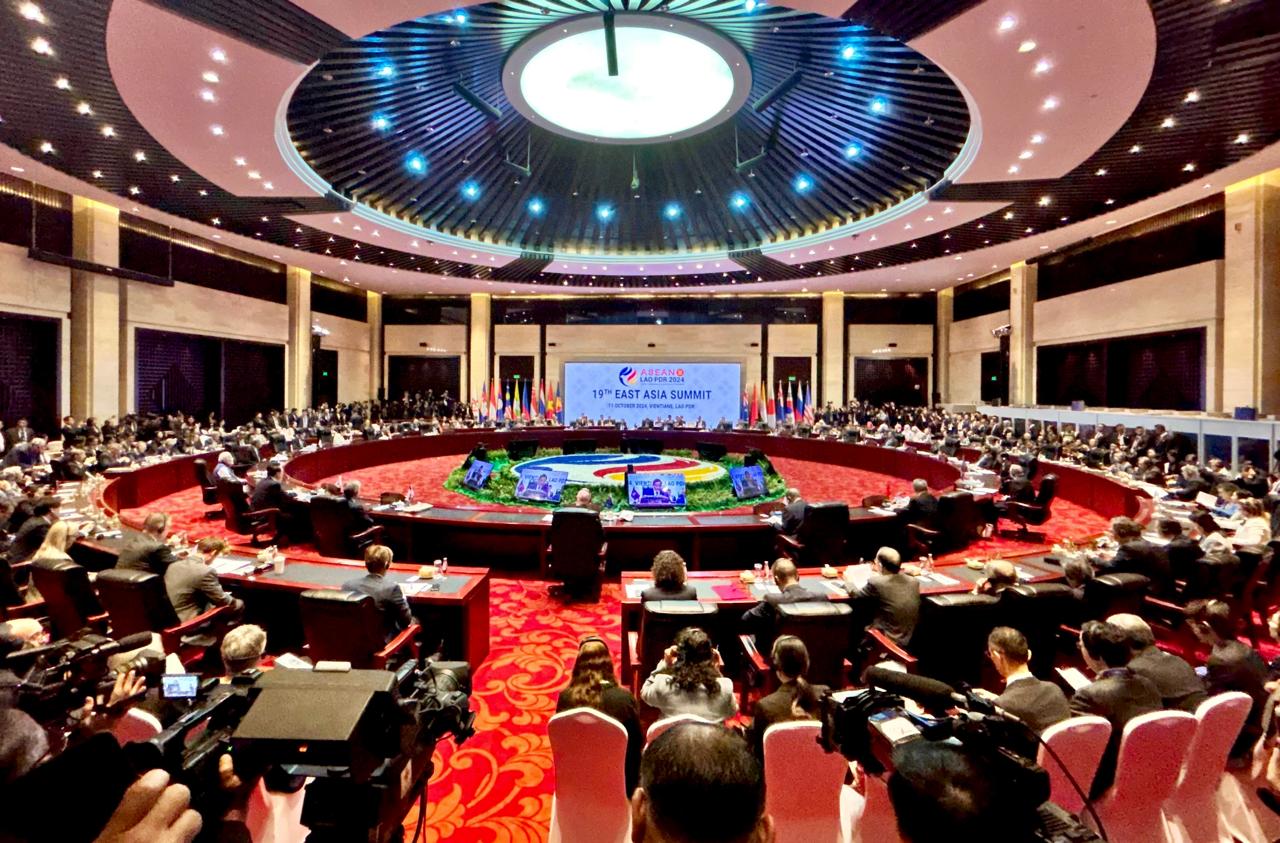
ASIATODAY.ID, VIENTIANE – The 19th East Asia Summit was held on Friday, 11 October 2024 at the National Convention Center, Vientiane, Laos.
The conference brought together China, India, Japan, New Zealand, South Korea, Russia, the United States (US), and ASEAN in one dialogue forum. As the premier leaders’ dialogue platform in the region, the East Asia Summit is a form of ASEAN’s active contribution in managing regional dynamics based on the values of the ASEAN Charter such as mutual respect, non-intervention, peaceful resolution and cooperation.
This year’s East Asia Summit meeting was attended by heads of government of member countries or their representatives, as well as the President of the European Council and the Secretary General of the Shanghai Cooperation Organization as Guests of the Chair. On this occasion, the leaders discussed a review of the development of cooperation under the East Asia Summit platform and developments in regional external relations.
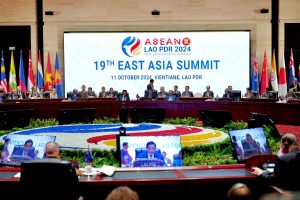
Several main issues discussed were developments in the geopolitical conditions of the Indo-Pacific, including the South China Sea, Myanmar, the Korean Peninsula, as well as conflicts in Ukraine and the Middle East.
The Heads of Government and representatives present at the East Asia Summit share the same view on the importance of maintaining regional peace and stability, which allows the Asia-Pacific to grow strong amidst global turmoil. The leaders exchanged views on multilateral cooperation based on international norms and law to manage conflicts in the region. The implementation of norms of mutual respect needs to be promoted in relations between countries, including respect for sovereignty and territorial integrity.
ASEAN dialogue partners agreed to support ASEAN centrality and ASEAN-led mechanisms, including through synergy with their respective Indo-Pacific strategies.
In front of the leaders of the East Asia Summit, the Vice President of the Republic of Indonesia, Ma’ruf Amin, expressed the importance of the region paying attention to current global conditions which are increasingly critical.
“The world is not okay. Conflicts and wars emerge, trust deficits increase, and constructive cooperation is difficult to realize. “If we don’t address this immediately, the future of the world, including achieving sustainable development (SDG) will only be a dream,” said Ma’ruf Amin, opening his speech.
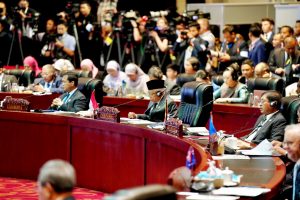
Ma’ruf Amin emphasized the importance of all countries making maximum efforts to maintain regional peace, stability and prosperity.
“Last year, we agreed on the importance of the East Asia Summit in maintaining and advancing the region as a world growth factor. Agreement alone is not enough. “Implementing commitments is key,” he explained.
For this reason, he highlighted several main issues that require concrete steps from the East Asia Summit;
The first is the situation in Palestine. Ma’ruf Amin expressed concern over the injustice and humanitarian crisis experienced by the Palestinian people and the widespread conflict around Gaza and the West Bank.
“As leaders, we must act and side with international law and humanity. “Don’t be selective in implementing international law,” he stressed.
On this occasion, Ma’ruf Amin also encouraged the implementation of Resolution ES 10/24 and the “Two State Solution” as the main reference for resolving the Palestinian problem.
Second, the East Asia Summit needs to be a medium for increasing mutual trust.
“We show that a culture of dialogue is important to reduce misunderstandings, help defuse tensions, and is the only way to overcome multidimensional challenges,” he said.
For this reason, Ma’ruf Amin encouraged the ASEAN Outlook on the Indo-Pacific (AOIP) to be used as a concrete collaboration guide to overcome regional challenges.
Ma’ruf Amin also raised the potential of the global halal market so that it can be optimized within the framework of this collaboration.
“The increasing demand for halal food, beverages, cosmetics and pharmaceutical products opens up significant opportunities for regional economic cooperation as well as wider access to global markets,” he said.
On this occasion, the Coordinating Minister for the Indonesian Economy, Airlangga Hartarto, also reinforced Vice President Ma’ruf Amin’s statement that the East Asia Summit must be a bridge for inclusive economic cooperation. The global economy is currently facing trade wars and protectionism, supply chain disruption, inflation and energy market volatility.
“Concrete cooperation must be created to realize the Regional Comprehensive Economic Partnership (RCEP) as concrete evidence of the region’s contribution in achieving connectivity and resilience,” concluded Airlangga. (AT Network)
Follow Us at Google News and WA Channel