
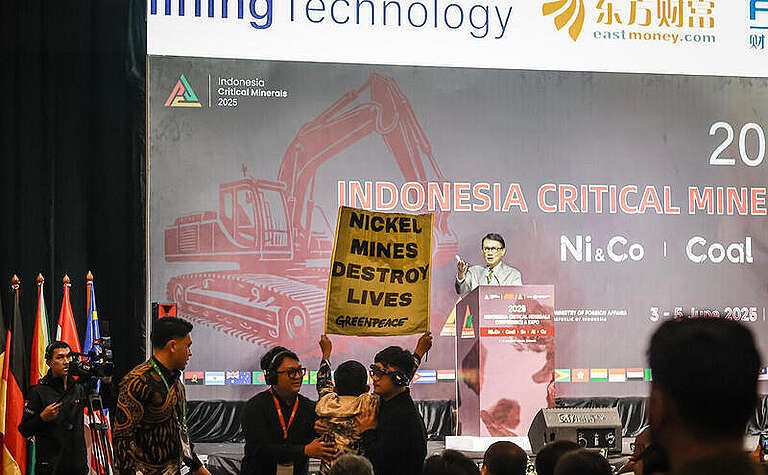
ASIATODAY.ID, JAKARTA — The Indonesia Critical Minerals Conference 2025 in Jakarta, June 3, 2025 took an unexpected turn when activists from Greenpeace Indonesia and four young Papuans from Raja Ampat staged a peaceful protest during the keynote speech by Deputy Foreign Minister Arief Havas Oegroseno.
The activists unfurled banners reading “Nickel Mines Destroy Lives” and “Save Raja Ampat from Nickel Mining” inside the conference hall. Another banner, stating “What’s the True Cost of Your Nickel?”, was displayed prominently, questioning the environmental and social price of nickel production in Indonesia.
Greenpeace Indonesia denounced the impacts of nickel mining and downstream processing, warning that the industry is inflicting severe harm on local communities and ecosystems.
According to the organization, nickel operations across Indonesia have led to deforestation, water and air pollution, and the use of coal-powered captive power plants that worsen the climate crisis.
“While government officials and mining oligarchs discuss expanding Indonesia’s nickel industry, our people and planet are already paying the price. Forests, rivers, land, and seas are being destroyed in the name of industrialization,” said Iqbal Damanik, Forest Campaigner for Greenpeace Indonesia.
He cited areas already suffering from industrial nickel mining, including Morowali, North Konawe, Kabaena, Wawonii, Halmahera, and Obi Island, and warned that Raja Ampat in Papua—one of the most biodiverse regions on Earth—is now under threat as well.
Raja Ampat at Risk: A Biodiversity Haven in Peril
Raja Ampat is world-renowned for its ecological richness. The region harbors over 75% of the world’s coral species and more than 2,500 species of fish. It is also home to 47 species of mammals and 274 species of birds. UNESCO has designated Raja Ampat a global geopark.
Yet Greenpeace’s investigation revealed ongoing nickel mining on Gag, Kawe, and Manuran Islands, all of which are categorized as small islands that, under Law No. 1/2014, should be protected from extractive activities. Over 500 hectares of forest and natural vegetation have been cleared on these islands. Documentation shows that sediment runoff from land clearing and excavation is already damaging coastal marine ecosystems, including coral reefs.
Other small islands under threat include Batang Pele and Manyaifun, located about 30 kilometers from Piaynemo, the iconic karst island cluster featured on Indonesia’s 100,000 rupiah banknote.
“Raja Ampat is our home. Nickel mining threatens our sea, our livelihoods, and the harmony of our communities,” said Ronisel Mambrasar, a youth activist from Manyaifun and member of the Save Raja Ampat Alliance.
Greenpeace Urges a Rethink of Indonesia’s Nickel Industrialization
Greenpeace Indonesia is calling on the Indonesian government to urgently review its nickel downstreaming policies—championed under President Joko Widodo and continued by the current Prabowo-Gibran administration.
They argue that this industrial push contradicts the goals of a just energy transition. Rather than leading to sustainable development, the nickel boom has brought environmental degradation, land grabs, and the dispossession of Indigenous and local communities—all while worsening the climate emergency.
In response to the protest, Deputy Foreign Minister Arief Havas downplayed the incident.
“It’s a regular protest. No problem. Environmental issues are a concern for all of us. We also want an environmentally friendly and socially responsible mining system,” he said.
However, he criticized the protesters’ approach.
“What I’m curious about is their method—it’s a bit immature. If they want to influence policy, they should engage in discussion and present strong arguments,” he added. (AT Network)
Follow Us at Google News and WA Channel