

ASIATODAY.ID, KAZAN – The number of Southeast Asian countries that want to join the BRICS group continues to grow. After Malaysia, now Indonesia is also ready to join the group.
The Minister of Foreign Affairs of the Republic of Indonesia, Sugiono, conveyed Indonesia’s desire to join BRICS at the BRICS Plus Summit in Kazan, Russia, October 24, 2024. With this announcement, Indonesia’s process to become a member of BRICS has begun.
Representing the President of Indonesia, Minister Sugiono as Special Envoy conveyed President Prabowo Subianto’s message regarding anti-colonialism and anti-oppression. In particular, Minister Sugiono emphasized solidarity and commitment to global peace and underlined the ongoing crises in Palestine and Lebanon.
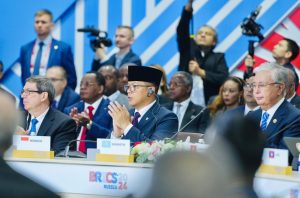
“Indonesia cannot remain silent while this cruelty continues without anyone being held accountable,” said Sugiono, quoted from MOFA.
Indonesia called for a ceasefire and enforcement of international law, as well as the importance of continued support for the recovery of Gaza.
Furthermore, Minister Sugiono proposed several concrete steps to strengthen cooperation between BRICS and the Global South.
First, upholding the right to sustainable development, where developing countries need policy space, while developed countries must fulfill their commitments.
Second, supporting the reform of the multilateral system to be more inclusive, representative, and in accordance with current realities. International institutions must be strengthened and have adequate resources to fulfill their mandates.
Lastly, being a force for unity and solidarity among Global South countries. BRICS is considered to be able to function as a glue to strengthen cooperation among developing countries.
“Indonesia’s joining BRICS is an embodiment of an active, free foreign policy,” said Sugiono.
“It does not mean that we join a particular camp, but we actively participate in all forums.”
“We also see that BRICS priorities are in line with the work program of the Red and White Cabinet, including food and energy security, poverty eradication or human resource development,” Sugiono added.
Through BRICS, Indonesia wants to raise the common interests of developing countries or the Global South.
“We see that BRICS can be the right vehicle to discuss and advance the common interests of the Global South,” Sugiono continued.
“However, we also continue our involvement or engagement in other forums, while also continuing discussions with developed countries.”
Concrete examples of this sustainability include, “Next month President Prabowo Subianto will attend the G20 Summit in Rio de Janeiro, Brazil, while I was also invited to attend the G7 expanded session of the Foreign Ministers’ Meeting in Fiuggi, Italy,” said Sugiono.
This emphasizes Indonesia’s important role as a bridge builder between developing and developed countries.
Minister Sugiono also used the opportunity in Kazan to hold various bilateral meetings, especially with Russian Foreign Minister Sergey Lavrov as the host, and other friendly partner countries, namely the Secretary General of the PLO Palestine, the Foreign Ministers of China, India, Thailand, the Minister of Economy of Malaysia and the President of the New Development Bank. In addition, Minister Sugiono also had introductory talks via telephone with the Foreign Ministers of Singapore and Cambodia. Meanwhile, BRICS is an informal group whose members were initially Brazil, Russia, India, China, and South Africa. This group was first initiated in 2006 to discuss current global issues. Its membership was expanded in 2023 with the joining of Ethiopia, Iran, Egypt, and the United Arab Emirates. (AT Network)
Follow Us at Google News and WA Channel