
ASIATODAY.ID, JAKARTA – Indonesia is moving to redefine the role of natural gas in its economic transformation as the country begins construction of the Abadi LNG Project in the Masela Block, one of Southeast Asia’s most significant energy developments.
Unlike conventional LNG projects focused primarily on export markets, Indonesia has decided to prioritize domestic utilization. The government has mandated that at least 60 percent of Masela gas production will be allocated for domestic needs, while exports will be limited to a maximum of 40 percent.
The policy highlights Jakarta’s ambition to transform natural resources into a foundation for industrial development, energy security, and economic value creation.
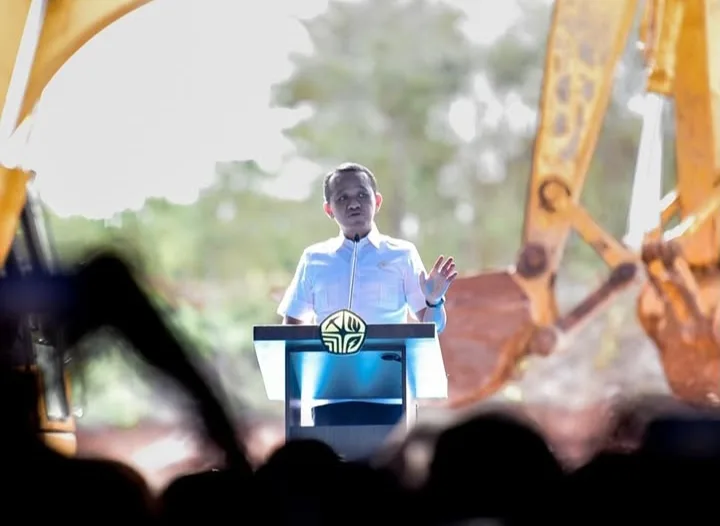
Energy and Mineral Resources Minister Bahlil Lahadalia announced the allocation policy during the groundbreaking ceremony of the Abadi LNG Project on Yamdena Island, Tanimbar Islands, Maluku.
“We will allocate a minimum of 60 percent of Masela gas production to fulfill domestic demand, while a maximum of 40 percent will be used for exports,” Bahlil said.
The domestic gas supply will support strategic sectors, including fertilizer production, electricity generation, gas distribution, and downstream industries.
Part of the allocation will support plans by the fertilizer sector to develop industrial facilities in the region, while other supplies will be directed to state electricity company PLN, gas infrastructure provider PGN, and selected private companies.
The government believes that domestic utilization of Masela gas will create broader economic benefits by strengthening industrial capacity and encouraging investment in eastern Indonesia.
A Strategic Energy Asset for Asia
Located approximately 180 kilometers offshore from Yamdena Island in the Arafura Sea, the Abadi Gas Field is one of Indonesia’s largest and most strategic gas resources.
The project is designed to produce around 9.5 million tonnes of LNG annually, along with 150 million standard cubic feet of pipeline gas per day and 35,000 barrels of condensate per day.
The development includes advanced offshore production facilities, subsea systems, a Floating Production Storage and Offloading (FPSO) facility, a gas export pipeline stretching approximately 175 kilometers, and an onshore LNG processing plant.
The project will also integrate Carbon Capture and Storage (CCS) technology, reflecting Indonesia’s effort to balance natural gas development with global emissions reduction commitments.
As Asian economies continue seeking reliable energy supplies amid geopolitical uncertainty and the global energy transition, Masela is expected to become an important component of Indonesia’s role in the region’s future energy landscape.
From Gas Development to Industrial Transformation
The USD20.9 billion project represents a major shift in Indonesia’s resource development strategy.
The government is seeking to move beyond the traditional model of exporting raw resources by using domestic energy supplies to strengthen manufacturing, downstream industries, and regional economic growth.
Through the Masela project, natural gas is positioned not only as an export commodity but also as a strategic driver for industrial competitiveness.
The allocation of gas for domestic industries is part of Indonesia’s broader policy to ensure that large-scale investments generate long-term economic value inside the country.
Local Communities at the Center of Development
Alongside energy and industrial priorities, the government has emphasized that local communities must become key beneficiaries of the project.
Bahlil said the government would protect the rights of residents in the Tanimbar Islands, including communities that have cultivated land for generations around the project area.
The government is preparing policies to ensure affected communities receive fair benefits from land utilization, including those whose traditional activities take place in areas classified as forest zones.
“We want a project of this scale to move forward without forgetting the rights of the people of the Tanimbar Islands,” Bahlil said.
The government has also instructed INPEX Masela Ltd., the project operator, to strengthen vocational training programs and prioritize local workers.
An agreement with INPEX President and CEO Takayuki Ueda established that communities closest to the project will receive priority access to employment opportunities before recruitment expands to other regions.
The initiative is expected to create opportunities for local residents during construction and future operations while developing a skilled workforce in eastern Indonesia.
A New Chapter for Indonesia’s Energy Future
The groundbreaking of the Abadi LNG Project marks a new chapter in Indonesia’s energy development journey.
With its combination of large-scale investment, domestic gas allocation, local workforce development, and lower-carbon technology, Masela is positioned as more than an LNG project.
It represents Indonesia’s ambition to build an energy system that supports industrial growth, strengthens national resilience, and contributes to the evolving energy landscape of Asia.
For Indonesia, Masela is not only about producing gas — it is about using energy as a foundation for a new era of economic transformation. (AT Network)
Follow Us at Google News, Instagram and LinkedIn