
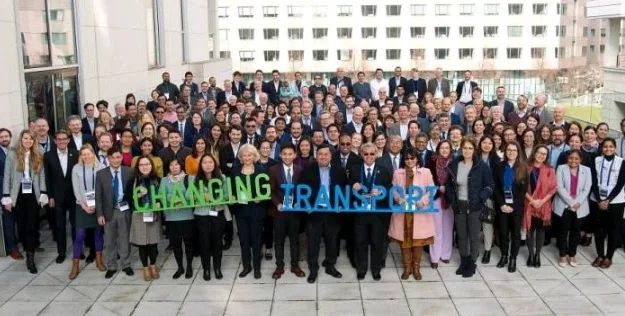
ASIATODAY.ID, BERLIN — As Indonesia faces surging urban mobility and mounting transportation challenges, an inspiring figure from Bogor, Lena Herliana, has emerged as a key driver of national public transport transformation—now carrying Indonesia’s agenda directly onto the European stage.
As the principal architect behind Indonesia’s Bus Rapid Transit (BRT) expansion, Lena has played a pivotal role in scaling modern urban bus systems across six strategic provinces: Jakarta, West Java, Central Java, Yogyakarta, East Java, and Bali.
These networks have become the backbone of daily mobility for millions of Indonesians, symbolizing the country’s accelerating shift toward sustainable and inclusive transportation.
Indonesia–Europe Transport Diplomacy Gains Momentum
In late 2025, Lena’s mission extended to Germany, a global hub for transport innovation and climate policy. There, she became actively involved in advancing Indonesia–Germany bilateral cooperation initiatives, while also opening dialogue with several other European partners.
The core focus of these engagements is clear: unlocking transport-sector investment opportunities in Indonesia, particularly in six priority provinces anchored by high-density and high-growth cities such as Jakarta, Bandung, Semarang, Yogyakarta, Surabaya, and Denpasar.
Beyond serving as economic and tourism centers, these cities have recorded annual public transport ridership growth of 50–70 percent, driven by robust economic expansion and Indonesia’s demographic dividend—making them increasingly attractive to global investors.
TRANSfer III and the Roadmap to Indonesia Emas 2045
Through the Indonesia–Germany Transport Cooperation (TRANSFER III) program, Lena—working closely with the Indonesian government, represented by the Ministry of Transportation and the Coordinating Ministry for Investment—has helped formulate an ambitious package of transport mitigation actions and strategic roadmaps aligned with Indonesia Emas 2045, the country’s long-term development vision.
Key pillars of the cooperation include:
– Decarbonization of freight transport across Java,
– Multimodal transport integration in Bali,
– Development of intermodal rail systems, and
– Green infrastructure investments to reduce carbon emissions and congestion in high-mobility corridors.
Across a series of high-level meetings in Europe, Lena also facilitated direct discussions between the Indonesian government, the German government, and international investment institutions, exploring bankable, long-term financing models for sustainable transport projects.
Toward the Indonesia–Germany High-Level Policy Dialogue
The diplomatic momentum is set to culminate in a High-Level Policy Dialogue between Indonesia and Germany, scheduled for February 2026. The forum is expected to play a critical role in mapping strategic sustainable development investments, with priority sectors including the Green Infrastructure Initiative (GII)—a flagship platform for future-ready, low-carbon transport solutions.
Government Backing: Net Zero and Green Investment
The initiative has received strong backing from Agus Harimurti Yudhoyono (AHY), Indonesia’s Coordinating Minister for Infrastructure, who emphasized that transport decarbonization is central to Indonesia’s commitment to Net Zero Emissions by 2050.
“Decarbonizing transport modes and freight logistics is a core objective for Indonesia in reducing global emissions. Strategic Indonesia–Germany studies on rail-based freight transport are highly relevant, provided they are supported by commercially viable investment opportunities,” AHY stated.
Global Commitments in Berlin and JETP Support
Indonesia’s commitment was further reinforced at the Transport and Climate Change Week in Berlin, an annual forum hosted by the German government marking a decade since the Paris Agreement.
Indonesia actively participated in sessions on transport decarbonization in Asia, including discussions on 2035 targets and truck electrification.
Indonesia–Germany cooperation has also been institutionalized through the Just Energy Transition Partnership (JETP). Together with Japan, Germany has contributed approximately USD 4 billion to support Indonesia’s energy transition, including sustainable transport development.
These funds are being directed toward rail and electric bus integration in Jakarta, Bandung, Semarang, Yogyakarta, Surabaya, and Denpasar—positioning the six provinces as flagship showcases of Indonesia’s green transport transformation amid rapidly rising urban mobility. (AT Network)
Follow Us at Google News and WA Channel