
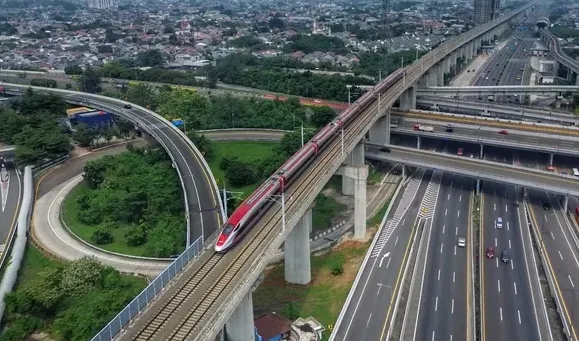
ASIATODAY.ID, JAKARTA — A high-level policy forum hosted by the Center for Indonesian Policy and Economic Studies (PPPI) at Paramadina University and the Institute for Development of Economics and Finance (INDEF) has reignited debate over one of President Joko Widodo’s most controversial infrastructure legacies — the Jakarta–Bandung high-speed rail project (KCIC), a joint venture with China, now mired in financial strain and public scrutiny.
Under the theme “Political Economy Lessons and Jokowi’s Policy Legacy: How to Pay for the High-Speed Rail Debt,” the discussion on October 22, 2025, revealed how the project, initially framed as a symbol of modernization, has become a debt trap testing Indonesia’s fiscal resilience and political credibility.
Dr. Eisha M. Rachbini, Program Director at INDEF, noted that while the vision of rapid intercity connectivity was laudable, the financial execution and governance failures turned an economic dream into a fiscal nightmare.
“Ideally, infrastructure of this scale should lift growth and welfare. But when financial management collapses, debt meant to drive progress ends up burdening the state,” she explained.
The financing structure leaned heavily on China Development Bank (CDB) loans — covering 75% of total funding — and 25% equity from a Chinese consortium. Indonesia’s side was represented by PT KAI and other state-owned enterprises within the PSBI (Pilar Sinergi BUMN Indonesia) consortium.
Originally priced at USD 5–6 billion, project costs have surged to USD 7.5 billion, inflated by cost overruns, currency depreciation, and Covid-related delays. Despite the government’s early assurance that no state funds would be used, fiscal injections through state capital (PMN) — including Rp 2.3 trillion in 2023 — were eventually made to support PT KAI’s debt burden.
“PSBI has posted continuous losses — Rp 0.97 trillion in 2023, Rp 4.2 trillion in 2024, and another Rp 1.6 trillion in 2025. KCIC remains financially unsustainable,” Rachbini warned.
PPPI researcher Muhammad Rosyid Jazuli described the Whoosh project as a “political economy nightmare” — not for its size, but for the chaos it created in public communication and inter-ministerial coordination.
“The debt isn’t huge compared to other ministries’ budgets, but politically it has exploded. In Indonesia, mid-level economic issues often turn into political crises when communication breaks down,” he argued.
Jazuli said the government’s inconsistent statements — from the Finance Minister’s rejection of APBN funding to Coordinating Minister Luhut Pandjaitan’s talk of restructuring the Chinese loan — have fueled public mistrust.
“This inconsistency makes the government appear divided, damaging confidence in its ability to manage long-term projects,” he added.
According to him, Whoosh should serve as a case study for technology transfer and governance reform, not as a prestige project.
“Indonesia must treat the Whoosh as a learning platform — not a vanity symbol.”
Dr. Handi Risza Idris, Vice-Rector of Paramadina University, raised a fundamental question:
“For a 150-kilometer route between Jakarta and Bandung, who truly benefits from this project — the Indonesian public or China’s industrial ambitions?”
He explained that while the Jakarta–Surabaya line was originally conceived under President Susilo Bambang Yudhoyono, President Jokowi later shortened it to the Jakarta–Bandung segment after choosing China’s cheaper offer over Japan’s more detailed feasibility plan.
But the financing gap widened, resulting in Rp 21.4 trillion in cost overruns. PT KAI and PSBI were forced to absorb the pressure as the Chinese side demanded government guarantees — effectively transforming a private venture into a state-backed debt obligation.
“What started as a purely commercial deal became a semi-sovereign debt issue. This is a heavy legacy for the next government to inherit,” Handi warned.
To prevent further fiscal fallout, Handi recommended restructuring the China-linked debt, acquiring assets, and capital injection through Danantara, along with extending the line to Surabaya and integrating it into broader transport networks.
Governance, Risk, and the China Factor
Beyond the financial arithmetic, experts agreed that the KCIC project reveals Indonesia’s systemic governance weaknesses — from political inconsistency to the lack of transparency in international infrastructure partnerships.
As of October 2025, the Whoosh line has carried over 12 million passengers, yet occupancy remains 40% below optimal levels, making it difficult to generate the revenue needed to cover long-term loans to China.
With the Finance Ministry refusing to use the state budget for further bailouts, Indonesia is now exploring debt restructuring and partial equity conversion — a delicate process that could redefine the country’s financial relations with Beijing.
The Jakarta–Bandung high-speed rail, once hailed as a landmark of Indonesia–China cooperation under Jokowi, now stands as a cautionary monument — a collision between political ambition, governance fragility, and debt dependency.
The pressing question remains: Who will ultimately pay for Indonesia’s high-speed dream with China?
(AT Network)
Follow Us at Google News and WA Channel